What Is Shockwave Therapy? A Detailed Guide
Wondering what shockwave therapy is, and whether it’ll work for your chronic pain? If you’ve been dealing with chronic tendon pain or a stubborn sports injury, exploring shockwave therapy can be worthwhile.
Originally developed for kidney stones, shockwave therapy is now one of physiotherapy’s most validated non-invasive treatments. In this guide, we’ll explain how shockwave therapy works, its benefits, and whether it’s the right treatment for you.
You Might Also Like: Sports dietitian services for your health and performance goals
Understand What Shockwave Therapy Is
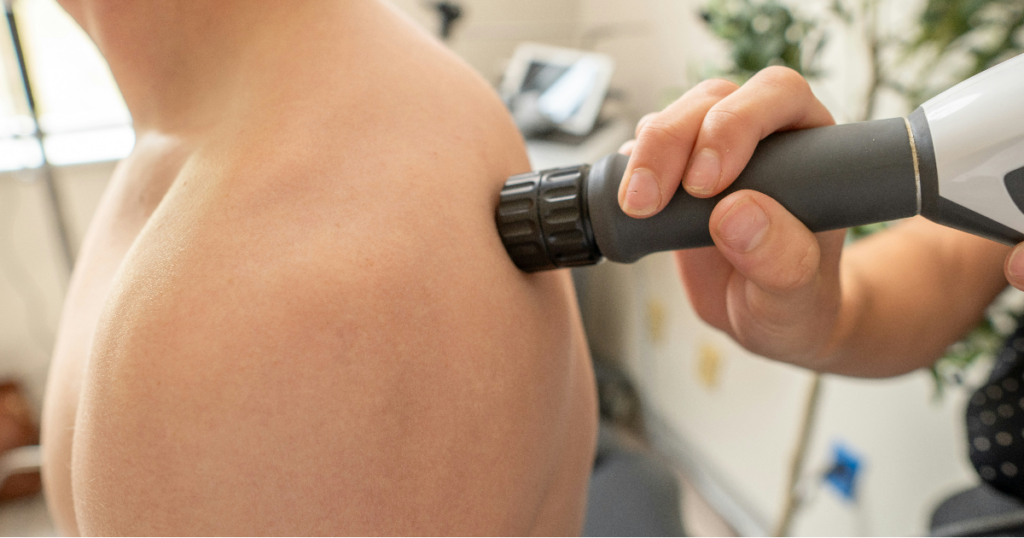
Shockwave therapy or Extracorporeal Shockwave Therapy (ESWT) is a non-invasive, outpatient treatment for chronic musculoskeletal pain, tendinopathies, and some bone injuries.
- “Extracorporeal” literally means “outside the body.” The treatment is applied externally through a handheld probe placed against the skin. There are no needles, no incisions, and no downtime involved.
- ESWT has been FDA-approved since 2000-2002 for multiple conditions including plantar fasciitis and tennis elbow.
- Shockwave therapy is widely supported by research: A review in the Journal of Orthopaedic Surgery and Research reports success rates ranging from 65% to 91% depending on the condition treated, with negligible side effects.
What Is the Mechanism Behind Shockwave Therapy?
ESWT acoustic waves don’t just numb pain; they trigger a cascade of biological events that stimulate real, lasting tissue repair.
- Breaking down scar tissue and calcifications: The waves disrupt fibrotic tissue and calcium deposits that form in tendons.
- Mechanotransduction: Pressure waves convert mechanical energy into cellular signals. This prompts injured cells to activate repair proteins and growth factors.
- Revascularization: ESWT promotes blood flow in the treated area. Improved blood flow means more oxygen and nutrients reaching the tissue, which dramatically accelerates healing.
- Nerve desensitization: The treatment stimulates nerve endings in a way that temporarily reduces pain signals. This offers relief even before full tissue repair is complete.
Check Out: Physiotherapy at Coastal Sports & Wellness and how it can complement ESWT.
Radial vs. Focused Shockwave: What’s the Difference?
Not all shockwave treatments are the same. There are two primary types, and choosing the right one depends on your specific injury and tissue depth.
Feature |
Radial Shockwave Therapy (rESWT) |
Focused Shockwave Therapy (fESWT) |
| Wave delivery | Spreads outward from probe | Concentrated at a focal point |
| Tissue depth | Superficial (3-4 cm) | Deep (up to 12 cm) |
| Best for | Heel pain, tennis elbow, trigger points | Calcific tendinopathy, deep bone pathology |
| Comfort level | Generally well tolerated | May be intense at higher energies, but overall not painful |
| Typical clinical setting | Physiotherapy clinic | Specialty musculoskeletal clinic |
Your practitioner will determine which type, or which combination, is most appropriate based on your diagnosis, imaging, and clinical presentation.
You Might Also Like: Osteopathic manual therapy as a multi-treatment approach to pain
What Conditions Does Shockwave Therapy Treat?
Heel and Foot Pain
- Plantar fasciitis is one of the most studied indications. One study found a 98% success rate at one-year follow-up using an individualized radial ESWT protocol, with only an 8% recurrence rate.
- Achilles tendinopathy, both mid-portion and insertional, responds well to ESWT, particularly when other conservative treatments have failed.
- The Royal Orthopaedic Hospital reports consistently achieving 75-80% success rates for heel pain patients treated with ESWT.
Shoulder Pain
- In case of calcific tendinopathy of the rotator cuff, focused ESWT is particularly effective. It helps physically break down and resorb calcium deposits.
- ESWT is also effective for frozen shoulders as it improves tissue regeneration and blood flow.
Elbow Conditions
- With lateral epicondylitis (Tennis Elbow) and medial epicondylitis (Golfer’s Elbow), both radial and focused ESWT are promising.
- Both therapies show significant pain reduction and grip strength improvement, with results continuing to improve over 12 weeks post-treatment.
Knee Conditions
- Patellar tendinopathy (Jumper’s Knee) affects approximately 14.2% of the overall sports injury population. ESWT is a common treatment recommendation for this condition.
- Emerging research shows both radial and focused ESWT can meaningfully reduce pain scores and improve range of motion in knee osteoarthritis.
Hip and Gluteal Pain
- Hip and gluteal pain respond well to ESWT. It can even resolve cases that have been unresponsive to cortisone injections for months.
- Hamstring tendinopathy is one notoriously stubborn condition in runners and cyclists that ESWT can help with.
Bone Conditions
- For conditions like stress fractures and non-union fractures, ESWT promotes bone remodeling, achieving radiographic healing.
- ESWT stimulates angiogenesis and osteogenesis, and thus works as a safe, low-complication alternative to surgery for repairing bone tissues.
You Might Also Like: Sport Physiotherapy at Coastal Sports & Wellness – ideal pairing with ESWT for sports-related injuries.
What Happens During a Shockwave Therapy Session?

If you’ve never had ESWT before, knowing what to expect can ease anxiety about the procedure.
Here’s a realistic step-by-step walkthrough:
- Assessment first: Your practitioner will palpate and identify the target tissue. In some cases, ultrasound imaging is used to precisely locate the pathology.
- Gel is applied: A conductive gel (similar to ultrasound gel) is placed on the skin to allow acoustic waves to transmit efficiently into the tissue.
- The probe is positioned: The handheld applicator is placed directly over the treatment area. You’ll hear a rhythmic clicking sound as waves are delivered.
- What it feels like: Most people describe a deep pressure with occasional snap sensations and discomfort at inflamed points. Sessions typically last 10-20 minutes and the sensation is entirely manageable.
- Post-session: Mild soreness, redness, or swelling in the treated area for 24-48 hours is normal. Post-session side effects are part of the inflammatory healing cascade that ESWT is designed to trigger.
Pro tip: Avoid anti-inflammatory medications or NSAIDs (like ibuprofen) in the days surrounding treatment. NSAIDs can blunt the very inflammatory response that drives ESWT’s healing mechanism.
Check Out: Laser therapy for faster cell growth and improved function
Is Shockwave Therapy Painful?
- Most patients find shockwave therapy comfortable and well-tolerated, with only mild sensations during treatment.
- You may feel light pulses or pressure, but the treatment is generally very tolerable.
- Some mild soreness similar to a workout can happen post-session, but usually fades quickly.
How Many Sessions Are Required?
The standard protocol is typically 3 to 6 sessions, spaced 1 to 2 weeks apart.
Some patients notice improvement after the first session, while others experience significant relief 4-6 weeks after their final treatment.
- Chronic, longstanding conditions (present more than 6 months) typically require more sessions and a longer recovery window.
- Acute or moderate injuries often respond faster and may require fewer sessions.
- Clinical guidelines recommend allowing at least 3-6 months post-treatment for full tissue remodeling.
Shockwave Therapy – Myths vs Facts
| ❌ Myth | ✅ Fact |
| It’s the same as electric shock therapy | ESWT uses acoustic pressure waves, not electricity. It is a completely different mechanism and sensation. |
| It’s experimental and unproven | FDA-approved since 2000. Backed by decades of peer-reviewed research across multiple conditions. |
| It’s unbearably painful | Most patients describe manageable pressure and mild discomfort. |
| Results are immediate | Some feel relief after Session 1, but full results develop over 6-12 weeks. |
| You need to rest completely after sessions | Light activity is encouraged. Only high-impact loading should be avoided in the 24-48 hours post-session. |
| One session is enough | A course of 3-6 sessions is standard. Single sessions rarely produce lasting outcomes. |
| It’s only for athletes | ESWT treats a wide range of patients, from office workers with elbow pain to older adults with heel pain. |
| It’s a last resort before surgery | ESWT is increasingly being used as a first-line treatment, not just a surgical alternative. |
Check Out: Massage Therapy at Coastal Sports & Wellness.
Who Is a Good Candidate, and Who Should Avoid Shockwave Therapy?
| Good Candidates | Not Suitable |
| Chronic tendon/soft tissue pain 3+ months | Pregnant women |
| Failed physiotherapy, massages, or injections | Active infection or open wound in area |
| Looking to avoid surgery | Severe clotting disorder or on blood thinners |
| Active person wanting faster return to sport | Pacemaker (near chest treatment) |
| Plantar fasciitis, calcific tendinopathy, bursitis | Growth plates (children/adolescents) |
| Overuse injuries in runners, athletes | Active malignancy in treatment area |
Always disclose your full medical history before beginning treatment. Your practitioner will conduct a thorough screening to confirm ESWT is appropriate for you.
Get expert shockwave therapy with Coastal Sports & Wellness in Halifax and Bedford. Book your initial assessment today, and take the first step toward real, lasting relief.
FAQs (Frequently Asked Questions)
Q. Does shockwave therapy hurt?
Most patients describe it as a deep pressure or mild sharp sensation at the most sensitive points. It’s uncomfortable for some, but not intolerable. Any soreness afterward is short-lived.
Q. Is shockwave therapy covered by insurance in Nova Scotia?
Coverage varies by provider and plan. ESWT offers direct billing options for most services. Contact Coastal Sports & Wellness directly or visit the insurance information page for more details.
Q. Can shockwave therapy replace surgery?
Yes. In many cases, it can replace surgery, or at least defer it significantly. ESWT is considered a viable non-surgical alternative for conditions like calcific tendinopathy and plantar fasciitis that have failed conservative management. Your clinician will advise if surgical consultation is still warranted.
Q. Can shockwave therapy be combined with other treatments?
Absolutely, and it’s often more effective when it is. Physiotherapy exercises, dry needling, chiropractic care, and massage therapy all complement ESWT well. Coastal Sports & Wellness specializes in integrating these approaches for optimal outcomes.
Q. Is shockwave therapy safe for older adults?
Yes, ESWT is well tolerated across a wide age range and it doesn’t carry the same risks associated with surgery or long-term pain medication use. The main contraindications are specific medical conditions rather than age, which make it a viable option for many older patients dealing with chronic tendon or joint pain.