How Pelvic Floor Physiotherapists Assess Movement Without Relying Only on Symptoms in Bedford
Understanding the Role of Movement in Pelvic Health
Pelvic floor physiotherapy is often associated with symptoms such as pelvic pain, bladder leakage, constipation, pressure, or discomfort during certain activities. While these symptoms are important, they do not always explain the full picture of how the body is moving and functioning. Pelvic floor physiotherapists also look at movement patterns, coordination, strength, breathing mechanics, posture, and the way different areas of the body work together. This broader assessment can help identify physical factors that may be contributing to a person’s concerns. In Bedford, people seeking pelvic health support may benefit from an assessment that considers both their reported symptoms and their individual movement patterns. At Coastal Sports And Wellness, we recognise that understanding movement can provide valuable information when developing an appropriate physiotherapy approach.
Why Symptoms Do Not Tell the Whole Story
Symptoms provide an important starting point during a pelvic floor physiotherapy assessment, but they are only one part of the clinical picture. Two people can experience similar symptoms while having very different movement patterns, muscle coordination, breathing habits, or physical limitations. Someone experiencing pelvic discomfort, for example, may also demonstrate changes in hip mobility or trunk control that are not immediately obvious from the symptoms themselves. Likewise, urinary urgency or leakage may occur alongside changes in breathing pressure, abdominal control, or pelvic floor coordination. This is why physiotherapists consider how the body behaves during movement rather than focusing exclusively on where a person feels discomfort. A movement-based assessment can help provide additional context that supports more individualised clinical decision-making.
Observing Posture and General Movement
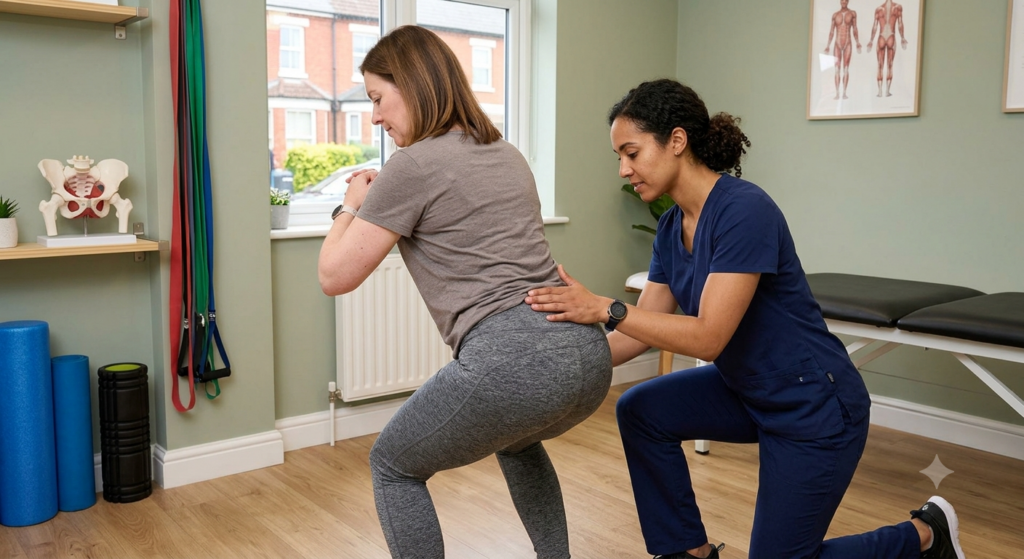
Posture can influence how different parts of the body share load during everyday activities, although posture alone does not necessarily indicate the presence of a pelvic floor problem. During an assessment, a physiotherapist may observe how a person stands, walks, sits, bends, reaches, squats, or changes position. These observations can reveal differences in mobility, balance, coordination, and muscular control. The goal is not to identify one supposedly perfect posture, because healthy movement can occur across a wide range of positions. Instead, the physiotherapist considers whether particular movement strategies appear limited, uncomfortable, inefficient, or difficult to control. This information can help guide further assessment and determine which physical factors may be relevant to the person’s goals.
Assessing Breathing and Pressure Management
Breathing is closely connected with the muscles of the abdomen, diaphragm, trunk, and pelvic floor, making respiratory mechanics an important part of many pelvic health assessments. Physiotherapists may observe how a person breathes at rest and how their breathing changes during movement or physical effort. They may also consider whether the person tends to hold their breath when lifting, exercising, changing position, or performing challenging movements. Changes in breathing strategy can affect how pressure is managed through the trunk during physical activity. This does not mean that a particular breathing pattern is automatically responsible for symptoms, but it can provide useful information about coordination and load management. Understanding these relationships can help a physiotherapist determine whether breathing and pressure strategies should be addressed as part of a broader rehabilitation plan.
Looking at the Hips, Spine and Lower Body
The pelvic floor does not function in isolation, so a pelvic floor physiotherapy assessment may include movement of the hips, pelvis, lower back, and legs. A physiotherapist may assess mobility and control during activities such as squatting, stepping, walking, or changing direction. Restrictions or differences in movement elsewhere in the body may influence how a person performs certain tasks, although they are not necessarily the direct cause of pelvic symptoms. The assessment therefore considers the interaction between multiple regions rather than automatically attributing every concern to the pelvic floor. This broader perspective can be particularly useful for active people whose pelvic health concerns appear during exercise, sport, lifting, or repetitive physical activities. By examining these relationships, the physiotherapist can develop a more complete understanding of the person’s movement capabilities.
Evaluating Pelvic Floor Muscle Coordination
Pelvic floor assessment may involve more than simply determining whether the muscles are strong or weak. Physiotherapists may consider whether the muscles can contract, relax, lengthen, and coordinate appropriately with breathing and movement. In some circumstances, a person may have difficulty relaxing muscles even though they can produce a strong contraction. In other situations, they may struggle to generate sufficient activation when it is needed for a particular task. The timing and coordination of muscle activity can therefore be as relevant as maximum strength. Any internal pelvic floor assessment should be discussed with the individual beforehand and performed only when clinically appropriate and with informed consent.
Examining Functional Movements
Functional movement provides an opportunity to see how the body responds to activities that resemble real-life demands. Depending on the individual’s concerns and goals, an assessment may involve movements such as getting out of a chair, lifting an object, performing a squat, walking, climbing stairs, or exercising. The physiotherapist can observe whether symptoms appear during particular movements and whether changes in technique alter the person’s experience. This does not mean that a movement causing discomfort is necessarily harmful or that there is always a single movement that needs to be corrected. Instead, the information can help identify patterns that may be worth exploring further. Functional assessment can make rehabilitation more relevant because treatment can be connected to the activities that matter most to the individual.
Considering Exercise and Sporting Demands
Pelvic floor concerns can occur in people who participate in running, strength training, recreational sports, dance, fitness classes, and other physically demanding activities. For these individuals, an assessment may need to consider how pelvic health interacts with exercise intensity, impact, fatigue, lifting demands, and sport-specific movement. A person may feel comfortable during basic daily activities but experience symptoms when running, jumping, changing direction, or lifting heavier loads. Examining movement under appropriate levels of challenge can provide information that a resting assessment cannot capture. Physiotherapists may therefore consider both current physical capacity and the demands that the person wants to return to. The objective is to understand movement in context rather than simply identifying whether symptoms are present.
Understanding Load and Capacity
Another important part of movement assessment is considering the relationship between physical load and the body’s current capacity. Pelvic floor symptoms may sometimes become noticeable after a change in training volume, occupational demands, exercise intensity, pregnancy-related changes, or other alterations in daily activity. This does not automatically mean that the activity itself is damaging. Instead, the physiotherapist may consider whether the person’s current capacity has adapted to the demands being placed on the body. Movement assessment can help identify opportunities to gradually build strength, endurance, coordination, and confidence. A carefully structured rehabilitation program can then progress according to the individual’s response and functional goals.
Assessing Movement Without Creating Fear
A useful pelvic health assessment should not make people feel that their bodies are fragile or that ordinary movement is inherently dangerous. Physiotherapists increasingly consider how to communicate movement findings without creating unnecessary fear around normal physical activity. Small differences in movement are common, and not every variation requires correction. The clinical relevance of a movement pattern depends on the individual’s symptoms, goals, physical capacity, history, and response to activity. This means an assessment should focus on useful information rather than labelling every movement difference as a problem. A clear explanation can help people understand what their physiotherapist is assessing and why particular exercises or strategies may be recommended.
Connecting Assessment Findings With Individual Goals
Movement assessment becomes more meaningful when it is connected to what the person actually wants to achieve. One person may want to walk comfortably, another may want to return to running, while someone else may simply want greater confidence during everyday activities. The assessment process can help identify which physical abilities are most relevant to those goals. Rather than applying exactly the same testing process to everyone, physiotherapists can select assessment techniques that provide useful information for the individual’s circumstances. This approach allows rehabilitation to focus on practical outcomes instead of symptoms alone. It can also make progress easier to recognise because improvements may involve movement confidence, exercise tolerance, coordination, or functional ability as well as changes in symptoms.
What a Pelvic Floor Physiotherapy Appointment May Involve
A pelvic floor physiotherapy appointment commonly begins with a detailed discussion about symptoms, medical history, lifestyle, activity levels, and personal goals. The physiotherapist may then perform relevant physical assessments based on the information gathered during the conversation. These assessments can include observation of posture, breathing, mobility, strength, coordination, functional movement, and other physical factors. An internal examination is not automatically required and should only be considered when appropriate, explained clearly, and agreed to by the patient. The findings are then used to discuss possible contributing factors and potential treatment options. This collaborative process gives the individual an opportunity to ask questions and understand the reasoning behind the recommended approach.
Taking a Whole-Body Approach to Pelvic Health
The pelvis is part of an interconnected movement system that includes the diaphragm, abdominal muscles, spinal structures, hips, legs, and pelvic floor muscles. Looking at these relationships can provide useful information when symptoms do not appear to have a straightforward explanation. A whole-body approach does not mean assuming that another body region is always responsible for pelvic symptoms. Instead, it recognises that movement involves coordination between multiple structures and systems. This perspective can be particularly valuable when symptoms change according to activity, position, intensity, or fatigue. It allows the physiotherapist to consider the broader physical context while keeping the person’s individual concerns at the centre of the assessment.
How Assessment Can Shape Rehabilitation
The information gathered during movement assessment can influence how rehabilitation is structured. Some people may benefit from improving pelvic floor muscle coordination, while others may need greater focus on strength, relaxation, breathing, mobility, movement confidence, or gradual exposure to specific activities. Exercises can be adjusted according to the person’s current ability and progressed as their capacity changes. The aim is not necessarily to perform the most exercises possible, but to select strategies that have a clear connection with the person’s needs and goals. Progress can then be monitored through symptoms, functional performance, exercise tolerance, and other relevant measures. At Coastal Sports And Wellness, we believe that this individualised approach can help make pelvic floor physiotherapy more practical, targeted, and meaningful.
When to Consider a Pelvic Floor Physiotherapy Assessment
People may consider pelvic floor physiotherapy when they experience symptoms involving bladder or bowel function, pelvic discomfort, pressure, difficulties with sexual activity, pregnancy-related changes, or challenges returning to exercise. However, an assessment can also be useful when symptoms are difficult to describe or appear only during particular movements or activities. A person does not necessarily need to wait until symptoms become severe before seeking professional guidance. Early assessment can provide an opportunity to understand movement patterns, discuss concerns, and identify appropriate strategies. A qualified physiotherapist can also determine whether further medical assessment or referral is appropriate when the presentation requires it. The most suitable approach depends on the individual’s circumstances, health history, symptoms, and goals.
Choosing a Movement-Focused Pelvic Health Approach in Bedford
Pelvic floor physiotherapy involves much more than asking where a person hurts or identifying whether a particular muscle is strong. A comprehensive assessment can consider movement quality, breathing, coordination, mobility, functional capacity, exercise demands, and the interaction between different areas of the body. These findings can provide valuable context and help the physiotherapist understand how a person’s concerns behave in real-world situations. The purpose is not to search for imperfections in normal movement, but to identify clinically useful information that can support appropriate rehabilitation. If you are considering pelvic floor physiotherapy in Bedford, discussing your concerns with a qualified professional can be a useful first step toward understanding your movement and functional goals. At Coastal Sports And Wellness, our approach is centred on understanding the individual rather than relying on symptoms alone.