Sports Chiropractor Bedford: What Happens When Recovery Focuses on Movement Instead of Symptoms Alone
Understanding Movement Based Recovery
When an injury occurs, pain is often the most noticeable signal that something is wrong. However, focusing only on where symptoms appear may not explain why the problem developed or why it continues to return. Movement based recovery looks beyond symptoms to understand how joints, muscles, connective tissues, posture, balance, and movement patterns work together. A sports chiropractor in Bedford can assess these factors to identify restrictions or compensations that may be affecting performance and recovery. Instead of treating discomfort as an isolated problem, the goal is to understand how the body is moving as a complete system. At Coastal Sports And Wellness, we use this broader perspective to help people work toward better movement and more sustainable recovery.
Why Symptoms Do Not Tell the Whole Story
Pain can provide important information, but it does not always identify the original source of a movement problem. For example, discomfort around the knee may sometimes be influenced by movement limitations at the ankle, hip, or surrounding muscles. Similarly, shoulder discomfort can sometimes be associated with mobility, stability, posture, or movement mechanics elsewhere in the body. This is why a detailed assessment can be valuable when symptoms persist or repeatedly return during physical activity. Looking at movement patterns may reveal factors that are not obvious when attention remains focused solely on the painful area. A movement focused approach therefore considers symptoms as one part of the overall assessment rather than the complete picture.
Assessing How the Body Moves
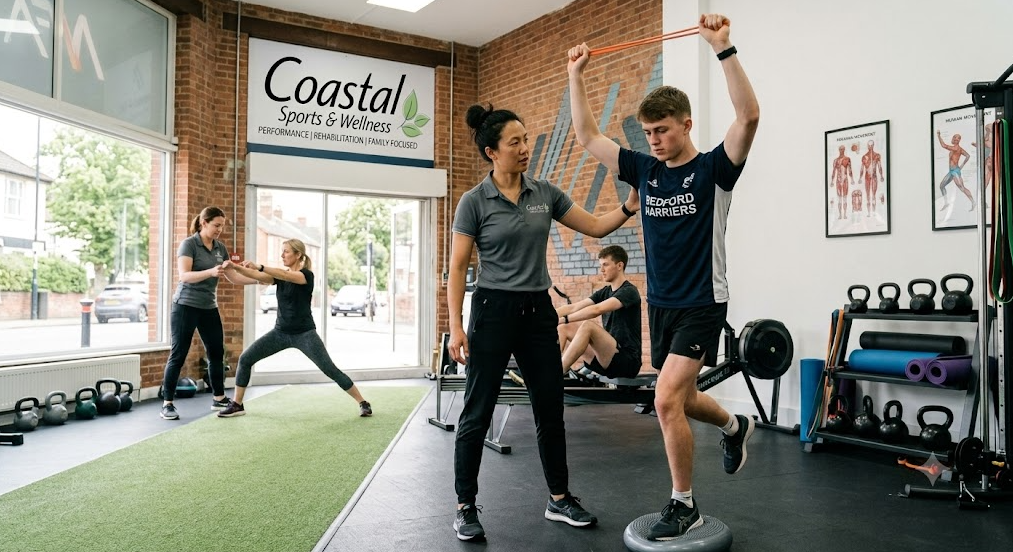
A sports chiropractic assessment can examine how different parts of the body coordinate during everyday and athletic movements. Depending on the individual, this may include observing mobility, joint function, muscular control, balance, posture, coordination, and movement patterns. The assessment can also consider the activities that place particular demands on the body, such as running, lifting, jumping, cycling, or sport specific movements. Understanding these demands helps create a recovery strategy that relates to the person’s actual goals rather than relying on a generic approach. The objective is to identify movement limitations and compensations that may influence comfort, efficiency, and physical performance. This information can then help guide appropriate treatment and rehabilitation strategies.
Connecting Mobility With Performance
Mobility is an important component of efficient movement because joints need an appropriate range of motion for many physical activities. When mobility is restricted, other areas may compensate to complete a movement that the body still needs to perform. These compensations can sometimes place additional demands on muscles, joints, or connective tissues. Improving movement quality may therefore involve addressing mobility while also developing strength and control within the available range. A sports chiropractor can consider how mobility limitations relate to the specific activities an individual performs. This creates an approach that connects treatment with practical movement rather than focusing exclusively on short term symptom reduction.
The Role of Strength and Stability
Movement quality depends on more than flexibility because the body also needs sufficient strength and stability to control available movement. A person may have adequate range of motion but still struggle to maintain control during activities that require speed, load, balance, or coordination. Recovery can therefore involve progressively challenging the body so it becomes more capable of handling the demands placed upon it. Exercises may be selected according to the person’s current abilities, symptoms, activity level, and recovery goals. Gradual progression allows physical capacity to develop while reducing the temptation to return immediately to demanding activities. Our approach at Coastal Sports And Wellness considers strength and stability as important components of building confidence in movement.
Looking at the Entire Movement Chain
The human body does not operate as a collection of completely independent parts during physical activity. Movements such as running, throwing, squatting, and jumping require multiple joints and muscle groups to coordinate through a connected kinetic chain. A limitation in one area can influence how another area contributes to the same movement. This does not mean that every symptom originates somewhere else, but it highlights why looking at the broader movement pattern can be useful. A sports chiropractor in Bedford may therefore assess regions above and below the area where symptoms are experienced. This wider assessment can help create a more complete understanding of the factors that may be influencing recovery.
Recovery Beyond Temporary Relief
Reducing discomfort can be an important part of recovery, but temporary symptom relief does not necessarily mean that the body is ready for full physical demands. Someone may feel better while still lacking the strength, coordination, mobility, or tolerance required for their usual activities. Returning to sport or exercise too quickly can place demands on tissues that have not yet regained sufficient capacity. Movement focused rehabilitation aims to progressively rebuild these physical qualities alongside symptom management. The process can involve gradually increasing activity while monitoring how the body responds to each stage. This approach places emphasis on restoring function so recovery is connected to what the person wants and needs to do.
Movement Confidence Matters
Injury recovery can affect confidence as well as physical ability, particularly when certain movements begin to feel uncertain or uncomfortable. People may start avoiding activities that previously felt natural because they associate specific movements with pain or the possibility of reinjury. Appropriate rehabilitation can help rebuild confidence by introducing movements progressively and allowing the body to adapt to increasing demands. Controlled exposure to movement can provide an opportunity to develop strength, coordination, and trust in physical capability. The process should be individualized because every person’s injury history, activity level, and recovery goals are different. A movement focused approach can therefore support both physical preparation and greater confidence in returning to meaningful activities.
Preparing for Real World Demands
Recovery should ultimately prepare the body for the movements and activities that matter to the individual. An office worker returning to regular exercise may have different physical requirements from a recreational runner, competitive athlete, or person who performs physically demanding work. Rehabilitation can be adjusted according to these differences rather than stopping once everyday symptoms become manageable. For athletes, this may involve progressively incorporating acceleration, deceleration, jumping, rotational movements, or sport specific patterns. For active adults, it may involve rebuilding tolerance for lifting, walking, running, recreational activities, or gym training. The goal is to make recovery relevant to real world demands rather than defining success only by whether symptoms have decreased.
Why Individualized Care Is Important
There is no single movement strategy that works identically for every person experiencing pain or recovering from an injury. Two people with similar symptoms may have completely different movement patterns, physical capacities, injury histories, and lifestyle demands. An individualized assessment allows treatment and rehabilitation to reflect these differences. It also provides an opportunity to modify exercises and activity progression according to how the person responds over time. This flexibility can be particularly valuable when recovery does not follow a straightforward path. At Coastal Sports And Wellness, our focus is on understanding the individual behind the symptoms and developing care around their movement needs and goals.
Supporting Long Term Physical Health
A movement focused approach can also encourage people to become more aware of how they use and prepare their bodies. Understanding movement limitations, training demands, recovery habits, and physical capacity can help individuals make more informed decisions about activity. This does not mean that every injury can be prevented or that movement assessment can eliminate all future symptoms. Instead, it provides useful information that can support better preparation and more appropriate progression. Regular attention to strength, mobility, coordination, and recovery can become part of a broader approach to physical wellbeing. Over time, this perspective can help people view recovery as an opportunity to build greater physical capacity rather than simply waiting for discomfort to disappear.
Choosing a Sports Chiropractor in Bedford
When looking for a sports chiropractor in Bedford, it can be useful to consider whether the approach addresses both current symptoms and the movements that matter to you. Ask how the assessment will consider your activity level, physical demands, previous injuries, and specific recovery goals. A thorough approach should recognize that symptom improvement and functional recovery are related but not always identical milestones. Understanding how treatment, exercise, and progressive movement will work together can also make the recovery process easier to follow. The right approach should be individualized and adjusted as your physical capacity changes throughout recovery. Our team at Coastal Sports And Wellness focuses on movement, function, and individualized care to help people work toward returning to the activities that are important to them.